|
|
 |
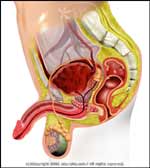
Normal |
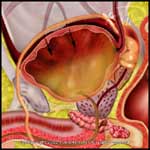
Abnormal |
| |
- Normally filtered urine from the
kidneys is stored in a balloon like muscular sac called the
bladder. It exits the body via a long, thin tube called a
Urethra.
- Conditions that block or make it
difficult for the urine to leave the bladder, or weaken its
muscular tone will result in the accumulation of the urine.
Once the bladder is full, the urine simply overflows, and
small amounts leak out without the person being able to
contain or hold it.
|
 |
- Obstruction of the Urethra:
- Enlarged Prostate
gland -- the prostate gland is only present in males, and
surrounds the urethra.
- Prostate Cancer or
tumors
- Urethral strictures -- Urethra can be damaged, causing thick scars (strictures) to form. This may occur due to previous infections, such as with Gonorrhea or
previous surgeries.
- Urinary tumors -- tumors can arise
within the bladder or urethra.
- Urinary stones -- bladder or kidney
stone can get stuck at the opening of or in the urethra.
- In females: ovarian tumors or benign tumors of
the uterus (fibroids)
|
 |
- Medical history and a general
physical exam is the first step in the process.
- The history of symptoms,
medications, illnesses, infections, surgeries, habits, and a
family history are also important.
- A general examination of the entire
body is necessary for a proper diagnosis.
- The physician may need to perform a
rectal examination in which the gloved index finger is
lubricated with a gel, and inserted into the rectum.
The prostate is then examined for size and tumors.
- In female patients, a pelvic exam
may also be done where 2 fingers of one gloved hand are
inserted inside the vagina, while the other hand feels the
lower abdomen for tumors or cysts.
- The rectal and pelvic exams are
slightly uncomfortable, but not painful.
- A continence calculator is a series
of questionnaires that help the doctor to distinguish
between various types of incontinence.
- A voiding diary is 24-hour record
of urination, and is often helpful with diagnosis.
- The blood may be tested for
diabetes, (and for prostate disease with a special prostate
test called PSA).
- PSA is a chemical in the prostate that, when found in
the blood, may indicate prostate enlargement or cancer.
- Blood may be tested for kidney function and
electrolytes.
- Urine samples may be sent for analysis if bleeding
(Hematuria) or an infection is suspected.
- Special tests are done to further study bladder function
and investigate the cause. These tests are done by a
urologist.
- Trans Rectal Ultrasound -- uses a small camera (size of
a hot dog) that is inserted in the rectum, and generates
sound to measure the size, and assess the structure of the
prostate.
- Cystoscopy uses a pen
like camera to give the urologist a direct view of the
urethra and the bladder.
- Urodynamics are used to measure pressure in the bladder,
and evaluate the flow of the urine.
- Cystometry is used to test the bladder muscle's
squeezing power, as well as the ability to hold urine.
- Uroflometry is a test in which the patient drinks water
until the bladder is full while sitting in a special chair
(void chair). The patient is then asked to cough, and
the volume of the urine that comes out is measured and
subtracted from the volume of the urine remaining in the
bladder. The remaining urine is measured by regular
Ultrasound, or a plastic tube is inserted into the bladder
via the urethra. This is called a urinary catheter.
- Pressure Flow studies are done by
placing a pressure sensor (wire) into the bladder and
recording its function and capacity.
- An Electromyography
or EMG is beneficial if nerve damage is suspected. A sensor
is placed inside the urethra or the bladder via a catheter,
and the electrical activity of the muscles is
recorded.
|
 |
- Males
- Age greater than 60
- Drugs and medications
- Alcohol
- Sexually transmitted diseases
- Diabetes
- Stroke
- Spinal cord injury
- Symptoms
- Sensation that the bladder is never
completely empty, even after urinating
- Urge to urinate, but unable to, or
only a small amount of urine comes out at any time.
- Dribbling small amounts of urine
even after using the bathroom.
- May not be able to voluntarily stop
urinating once you have started
- Decreased force of urination
- Pain or fullness below the belly
button where the bladder is located
- Frequent urination
- Nocturia -- Getting up more than 3-4
times at night to urinate.
- Social isolation, embarrassment, dependence, and Depression can occur,
especially in the elderly.
|
 |
- Timed voiding refers to the times when
the patient records urination patterns (leakage, urination)
on a special chart reviewed by the physician. The doctor
then finds patterns in the chart, and the patient uses this
timetable to empty the bladder before leakage can occur.
- Bladder training refers to the times
when the patient tries to control and resist the urge to
urinate.
- The urination is done according to
a timetable (i.e., every hour etc.). Special muscle
contraction exercises called Kegel exercises(hold-release-urinate)
strengthen weak muscles around the bladder.
- If the prostate is enlarged (BPH), medications such as Hytrin may be prescribed.
- If medications are not helpful, then
surgery may in fact be needed
- Strictures are also corrected with
surgery
- The distended bladder may need to be
emptied with frequent timed catheter insertions by the
patient to empty the urine.
- Devices such as urethral inserts
(small tubes) can be placed to keep the urethra open.
- Medications such as Ditropan may help in
certain cases such as in diabetes cystopathy.
- Avoid an excess of coffee and
alcohol.
- Ask your doctor if diuretics such as Lasix can be stopped
- Drink plenty of fluids, but only
small amounts at a time
- Control your glucose if you have
diabetes and this condition.
|
 |
- Contact your doctor and remember --
there are plenty of therapies that work.
- Get yearly prostate exams after 40, and for females, make sure your keep
up your pelvic exams.
|
 |
- Diabetes -- nerves damaged by
long-term uncontrolled diabetes causes bladder weakness
(cystopathy).
- Spinal cord trauma
- Strokes
- Drugs, narcotics, alcohol, anticholinergics, (Atropine, Bentyl) and some anti
depressants
- Other types of incontinence:
- When urine leaks with coughing,
physical activity, or any other like forms of stress that
may occur
- The inability to hold urine, as seen with the use of diuretic medications such as Lasix or after
menopause.
- Mixed
- Neurogenic, as in Parkinson's and
diabetes
- Post prostatectomy -- after the
prostate is removed
- Prostate Infection or Prostatitis
- Bladder neck abnormalities that are present at birth
|
| | |
If you want your friend to read or know about this article, Click here
 |
|
|