|
|
 |
Hansen's disease
|
 |
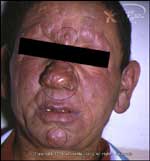
Abnormal |
| |
- Leprosy is an
infection caused by the acid-fast (i.e., retains stains by dyes) bacterium, Mycobacterium leprae. It is probably transmitted person-to-person via the respiratory tract (respiratory droplets). Contact with armadillos and possibly mosquitoes and bedbugs are also possible methods of infection.
- The disease usually results from prolonged exposure during childhood and occurs in tropical and subtropical areas of Asia, Africa, Central and South America, Pacific regions, and southern USA. Leprosy is divided into two types: lepromatous type, which occurs in persons with a deficient cellular immune system; and tuberculoid type (normal cellular immune system). The lepromatous type is more aggressive.
|
 |
- Pale, raised, nodular, or red skin lesions 1-10cm
- These lesions may be anesthetic (lack feeling), have unusual sensations, or be painful.
- The nose, eyes, throat, testicles, and superficial nerves may be affected with similar lesions.
- Ulcers on fingers or toes -- may cause them to shorten.
|
 |
- Skin scrapings show acid-fast (a type of laboratory stain) rodlike bacteria.
- Biopsy has typical histologic (microscopic) appearance. It will also be possible to divide the two types: lepromatous and tuberculoid.
- This bacterium will not grow in the lab.
|
 |
- Three-drug regimen: Dapsone, clofazimine, and rifampin. Treatment is usually continued for five years because relapses are common.
- Indeterminate tuberculoid Leprosy -- Dapsone and rifampin for six months is recommended.
|
 |
- Liver enlargement and kidney failure may occur with long-standing disease.
|
| | |
If you want your friend to read or know about this article, Click here
 |
|
|